Honoring Astor Piazzolla
Madison Tango Society | MAR 6
Honoring Astor Piazzolla
Madison Tango Society | MAR 6
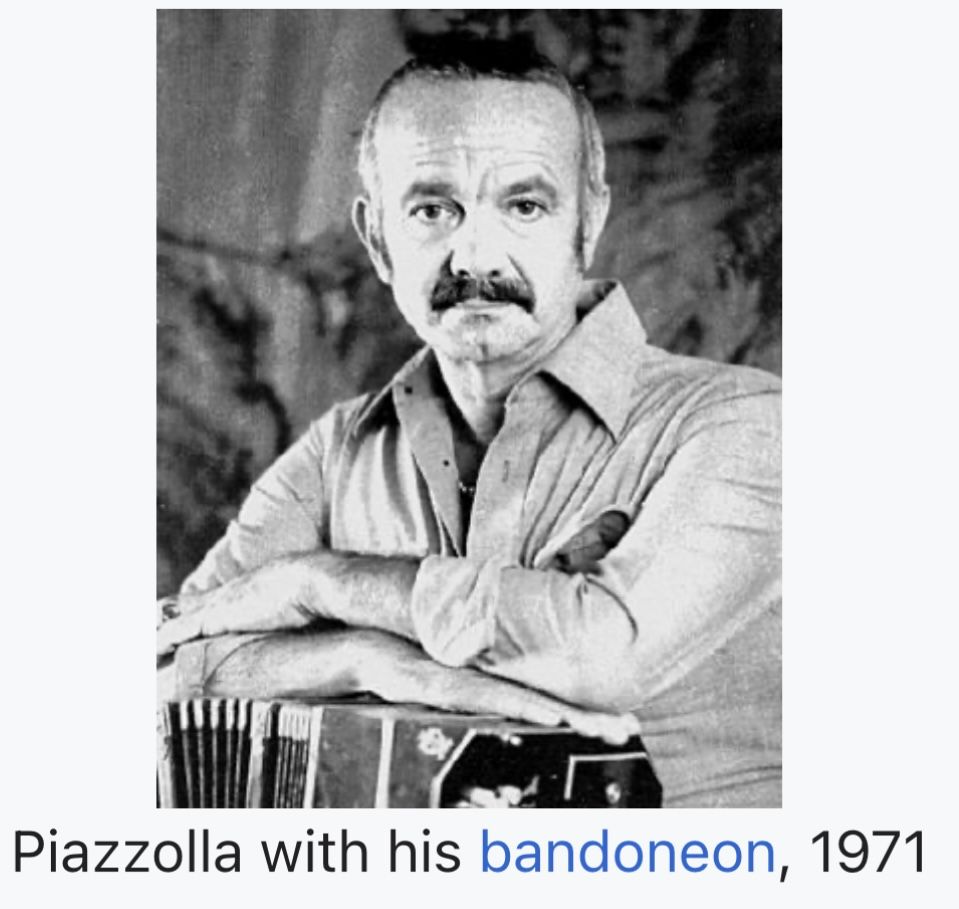
March 11th marks the birthday of Astor Piazzolla (March 11, 1921 - July 4, 1992), the renowned Argentine tango composer, extraordinary bandoneon player and innovative arranger. Worldwide, Piazzolla is the most famous tango music composer (and so many people ONLY know tango music of his!) Countless tango dancers have been drawn to tango because of his music, and he is often credited as a substantial reason that tango didn't completely die out.
A virtuoso bandoneonist, Piazzolla regularly performed his own compositions with a variety of orchestras. He was a prolific composer, writing an estimated 3,000 pieces and recorded around 500.
So why do Tango DJs hesitate to play his music at a milonga? Looking at Piazzolla's background and life events can help us understand his innovations in tango music.
Early Influences
Astor Piazzolla was born in Mar del Plata, Argentina in 1921, the only child of Italian immigrant parents. In 1925 Piazzolla moved with his family to Greenwich Village in New York City. Here from an early age, he would listen to his father's tango records of Carlos Gardel and Julio de Caro, and was exposed to jazz and classical music, including Bach. He began to play the bandoneon after his father spotted one in a New York pawn shop in 1929.
In 1932 Piazzolla composed his first tango, "La Catinga". The following year he began music lessons with the Hungarian classical pianist Béla Wilda, a student of Rachmaninoff who taught him to play Bach on his bandoneon. At 13 years old in 1934, Piazzolla met the famous tango figure Carlos Gardel, and played a cameo role as a paper boy in Gardel’s movie El día que me quieras. Gardel invited the young bandoneon player to join him on tour, but Piazzolla’s father decided that he was not old enough to go along - much to Piazzolla's dismay. This proved to be fortunate, as in 1935 on this tour, Gardel and his entire orchestra perished in a plane crash. In later years Piazzolla jokingly made light of this fateful event: if his father had let him travel on the tour, Piazzolla would have played the harp instead of the bandoneon!
In 1936, Piazzolla returned with his family to Mar del Plata, where he began to play in a variety of tango orchestras. At this time he discovered on the radio the music of Elvino Vardaro’s sextet whose novel interpretation of tango left a great impression on Piazzolla.
Training and Career
Still only 17 years old, Piazzolla moved to Buenos Aires in 1938 and the following year, he joined the orchestra of the bandoneonist Aníbal Troilo, which would become one of that era's greatest tango orchestras. In addition to playing the bandoneon, Piazzolla also began arranging music for Troilo and occasionally would also play the piano in his orchestra.
By 1941 Piazzolla earned a good enough wage to afford music lessons with Alberto Ginastera, an eminent Argentine classical music composer. Pianist Arthur Rubinstein, who was then living in Buenos Aires, advised him to study with Ginastera and to review musical scores of Stravinsky, Bartók, Ravel, and others, Piazzolla rose early each morning to hear the Teatro Colón orchestra rehearse while continuing to play tango clubs late into the night. He studied five years with Ginastera and mastered orchestration, which he later considered to be one of his strengths. From 1943 to 1948, he took piano lessons with the Argentine classical pianist Raúl Spivak.
During this time, Troilo began to question the advanced musical ideas of the young bandoneonist, whether it undermined his orchestra’s style or made the music less appealing to tango dancers. Tensions mounted between these bandoneonists until, in 1944, Piazzolla announced his intention to leave Troilo and join the orchestra of the tango singer and bandoneonist Francisco Fiorentino. Piazzolla would lead Fiorentino's orchestra until 1946 and make many recordings with him.
In 1946 Piazzolla formed his Orquesta Típica, giving him the opportunity to experiment with the orchestration and tango musical content. By 1950 he had disbanded his first orchestra and almost abandoned tango altogether as he continued to study Bartok and Stravinsky, to listen to jazz, and to search for his own musical style beyond tango, dedicating himself to writing and studying music. He decided to discontinue the bandoneon.
Piazzolla entered his classical composition "Buenos Aires Symphony in Three Movements" for the 1953 Fabian Sevitzky Award. As part of the competition for the prize, a symphony orchestra performance of the piece took place under the direction of Sevitzky himself. At the end of the concert, a fight broke out among members of the audience who were offended by the inclusion of two bandoneons in a traditional symphony orchestra. Despite this, Piazzolla's composition won him a grant from the French government to study in Paris with the legendary French composition teacher Nadia Boulanger.
Tired of tango, in Paris Piazzolla tried to hide his tango and bandoneon compositions from Boulanger, thinking that his destiny lay in classical music. Introducing his work, Piazzolla played her a number of his classically inspired compositions, but it was not until he played his tango Triunfal that she congratulated him and encouraged him to pursue his career in tango, recognizing that this was his talent. It proved to be a historic encounter and a crossroads in Piazzolla's career.
Piazzolla received the news of this father’s death in October 1959 while performing with tango dancers Juan Carlos Copes and María Nieves in Puerto Rico. When he returned a few days later to New York City, he asked to be left alone in his apartment and in less than an hour wrote his famous tango Adiós Nonino, in homage to his father.
Returning to Argentina, Piazzolla formed his new group, an octet, which effectively broke the mold of traditional tango orchestras and created a new sound with jazz-like improvisations - a watershed in the history of tango.
After a period of great productivity as a composer, he suffered a heart attack in 1973. That same year he moved to Italy where he began a series of recordings. His famous album Libertango was recorded in Milan in May 1974.
Blending jazz and tango, Piazzolla toured the world, performing live concerts and at jazz festivals with his own orchestras and with others, and recording the music he composed. In 1982 he recorded the album Oblivion with an orchestra in Italy for the film Enrico IV, directed by Marco Bellocchio, and in May 1982, in the middle of the Falklands War, he played in a concert at the Teatro Regina, Buenos Aires with the tango singer Roberto Goyeneche. On 6 September 1987, he gave a concert in New York's Central Park, in the city where he spent his childhood.
He suffered a cerebral hemorrhage in Paris on August 4, 1990, which left him in a coma. Piazzolla died without regaining consciousness less than two years later, in Buenos Aires on July 4, 1992.
Piazzolla's Impact on Music
Piazzolla revolutionized tango music into a new style distinct from traditional tango, dubbed nuevo tango - incorporating jazz and classical music elements, extended harmonies and dissonance, and using counterpoint. His music gained acceptance in Europe and North America, and was embraced by some liberal segments of Argentine society, who were pushing for political changes in parallel to his musical revolution, but it made him a controversial figure in his native land both musically and politically. Piazzolla's music worked within the historical backdrop stemming from 1955, when a number of political and social developments influenced Argentina's culture to become more performance focused and less amenable to social assemblies like tango milongas, which may have resulted in a backlash amongst conservative tango aficionados in Argentina.
Piazzolla completely changed the essence of the tango, yet he never intended his music to be danced tango to.
Piazzolla’s open-minded attitude to existing music styles has been compared to the mindsets of classical composers Handel and Mozart, who worked to assimilate all national "flavors" of their day into their own compositions. This mindset fused music styles, yet Piazzolla's music received an enthusiastic reception, even among classical and jazz musicians, both groups seeing aspects of their own music practices reflected in his innovative work.
Madison Tango Society | MAR 6
Share this blog post
 OfferingTree