What is Baldosa?
Madison Tango Society | MAR 1, 2026
Madison Tango Society | MAR 1, 2026
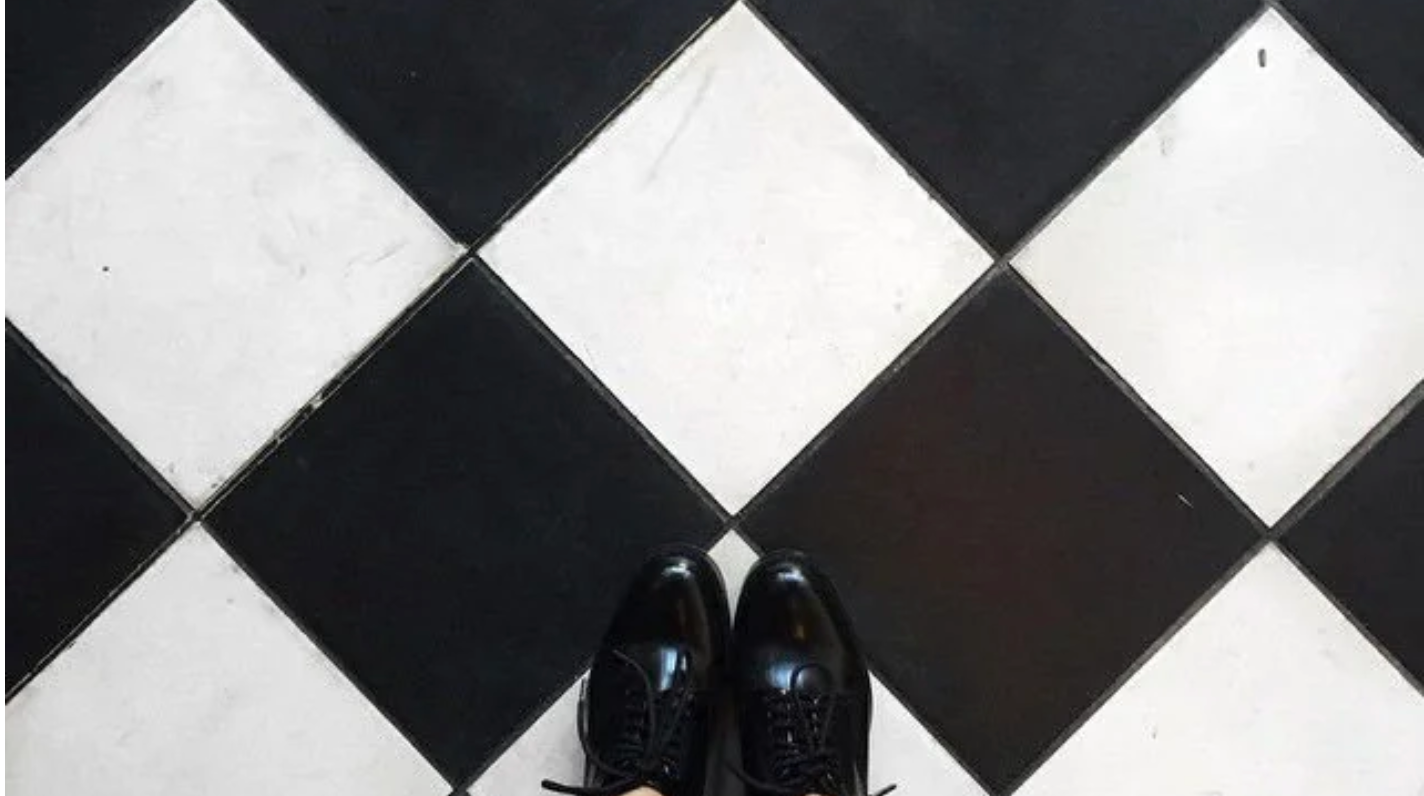
In the 1950 film Sunset Boulevard, Norma Desmond, played by Gloria Swanson, says to Joe Gillis "You know, this floor used to be wood, but I had it changed. Valentino said there's nothing like tile for the tango".
We all enjoy dancing on a great wood floor - so why switch to tile? Well, it’s Baldosa!
In the most literal sense, a baldosa or baldoza is a flat ceramic floor tile that was used in the cafes, and bakeries of immigrant neighborhoods of Buenos Aires, Argentina - neighborhoods like La Boca and San Telmo. Early tango dancers literally learned tango step geometry on tiles, developing skill and creativity in tight quarters. This origin reflects tango’s humble beginnings and its emphasis on close connection over showiness.
Even today, in many of the older Buenos Aires dance halls, the large black and white baldosa tiles are still common.
When used in tango, the term baldosa (sometimes also called mosaico for mosaic) is a fundamental six-step sequence that forms a small box or rectangle on the floor. It recalls the big black and white checkerboard baldosa floor tiles popular in 1800s Buenos Aires. The dance sequence is simple: a step back, a side step, a step forward to meet the feet, another step forward, a side step, and a final step to close – although including the first step as backwards can be controversial, especially when floor space is limited.
By Buenos Aires standards through the years, a good dancer is someone who can dance very contained on a tiled square, a baldosa. The great tangueros maintain a beautiful tango even in tight space. When you can maintain rhythm and a great embrace in a very small space on the tango floor, you are ‘dancing on the baldosa’.
Many tango students will learn the baldosa as the first tango pattern they learn, one that could fit neatly onto a single tile. But to say it is just a pattern is like saying a heartbeat is just a sound.
Indeed, some dancers say that the baldosa is the soul of tango and its intimacy. In the crowded milongas of Buenos Aires, dancers do not have the luxury of an entire ballroom for their dance. Rather, they have a small patch of floor in the current in a river of dancers. The baldosa enables that secret conversation of movement held in a crowded room. This small square becomes the dancers’ universe.
The old milongueros who were masters of tango didn’t learn tango from videos or diagrams. They learned by feeling the floor beneath their feet, by repeating this simple square until it became as natural as breathing. They carried the memory of that single tile with them onto the polished floors of the grand salons, never forgetting that the essence of tango lies not in the size of the floor, but in the depth of the connection.
“The floor gives you a single tile, a baldosa. The music gives you eternity. The embrace gives you the world. What more do you need to dance?”
— An old milonguero in Café Tortoni, Buenos Aires

Madison Tango Society | MAR 1, 2026
Share this blog post
 OfferingTree